.png?width=1774&height=887&name=ChatGPT%20Image%20Aug%203%2c%202026%2c%2001_58_55%20PM%20(2).png)
CMMC Compliance
CUI Scoping
CUI Discovery
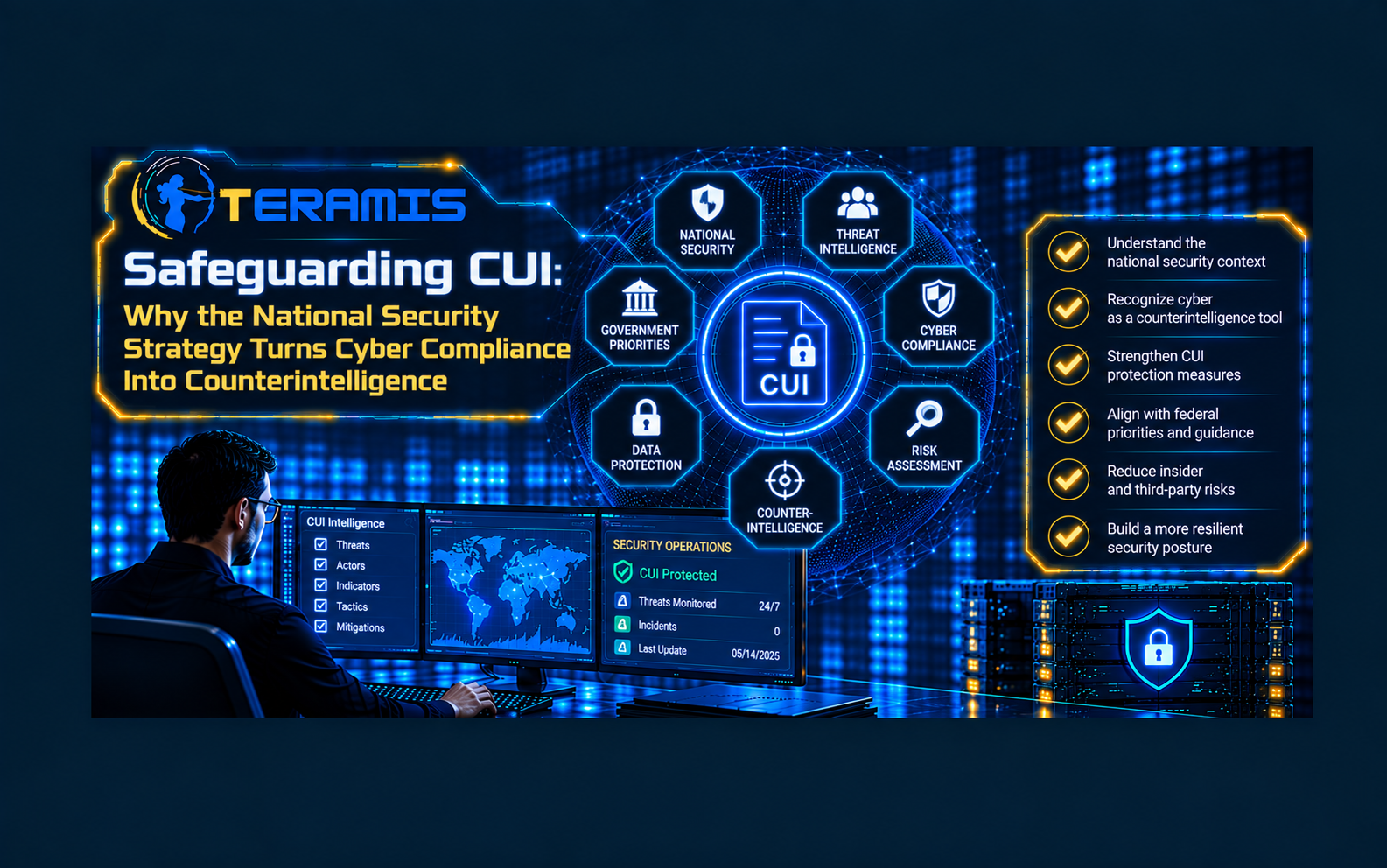

For years, cybersecurity compliance in the Defense Industrial Base (DIB) has been framed as an IT problem. A checklist. A maturity model. Something to survive long enough to pass an audit.
The November 2025 National Security Strategy of the United States makes clear that era is over.
The document does not mention CMMC by name, but it doesn’t need to. Its language fundamentally reframes how the U.S. government views cyber risk across the defense supply chain. The shift is unmistakable: cybersecurity is no longer about protecting systems; it is about preventing adversaries from exploiting data, access, and trust.
For defense contractors, that has profound implications for safeguarding CUI.
The Strategy repeatedly emphasizes threats that go well beyond routine cybercrime. It highlights:
This is not the language of IT best practices. It is the language of counterintelligence.
The document frames hostile cyber activity as a strategic weapon, used to undermine military readiness, hollow out industrial capacity, and extract sensitive information without firing a shot. In that context, mishandling Controlled Unclassified Information is no longer a technical failure. It is a national security exposure.
The Strategy states plainly that the United States must “protect our intellectual property from foreign theft,” and that American economic and military power depend on preserving technological and industrial advantages.
For the DIB, CUI is where those advantages live.
Engineering drawings. Program data. Test results. Operational details. Contract performance information. All of it represents intelligence value to adversaries. And all of it increasingly sits outside traditional DoD networks, inside contractor environments.
That reality drives a clear expectation embedded throughout the Strategy: organizations must know their risk surface, not assume it.
Safeguarding CUI now means being able to answer, with confidence:
Anything less is no longer “immature security.” It is blindness.
One of the most consequential implications of the Strategy is what it signals about enforcement posture.
The document stresses competence, accountability, and merit, warning that complex systems “will cease to function” if those principles are undermined. Applied to cybersecurity, that is a direct rebuke of performative compliance.
In practical terms, this means:
“Paper compliance” is no longer just ineffective. It is legally and reputationally radioactive.
This Strategy provides the policy foundation for aggressive use of existing enforcement mechanisms—False Claims Act actions, contract termination, suspension, and debarment—once cybersecurity representations become contractual claims.
The Strategy repeatedly ties cybersecurity to supply-chain security, noting that adversaries target the “defense industrial base and defense-related production capacity” precisely because of its distributed nature 2025-National-Security-Strategy.
That means CUI exposure at a subcontractor is not viewed in isolation. It is viewed as:
Safeguarding CUI is therefore no longer about protecting your organization. It is about preserving collective defense integrity.
The National Security Strategy draws a bright line: cybersecurity failures that expose sensitive data are strategic failures.
DIB leaders should take note:
The Strategy does not threaten contractors—it redefines their role. Industry is no longer adjacent to national security. It is embedded within it.
And in that reality, safeguarding CUI is not a compliance exercise. It is a counterintelligence responsibility.
Reference: